

AINEN
LOCATION İstanbul. TR
TYPE F&B
Lighting Consultant NOX
COMPLETION 2025
Photographer İbrahim Özbunar - 645 Studio
Although AINEN is programmatically defined as a food-and-beverage venue, it was deliberately conceived as an experiential space that consciously rejects the direct architectural representation of this typology. The project’s point of departure was not to reproduce familiar spatial images, but to transform a limited and problematic volume into a structure open to multiple modes of use and experience.

The kitchen-oriented program was not treated as the primary driver of the design; rather, it remained a background datum informing architectural decisions without dictating them.
Located within Tersane İstanbul, the leased space was characterized by a small footprint and an extremely narrow, elongated form—conditions that carried a high risk of turning the interior into a corridor-like space and fragmenting spatial continuity. Instead of attempting to resolve this disadvantage horizontally, the design strategy focused on activating the space vertically. The ceiling height was identified as a latent potential and was articulated through a three-dimensional ceiling intervention that introduced direction, rhythm, and dynamism. This gesture was conceived not merely as a formal move, but as an element that reshapes perception and the relationships established within the space.
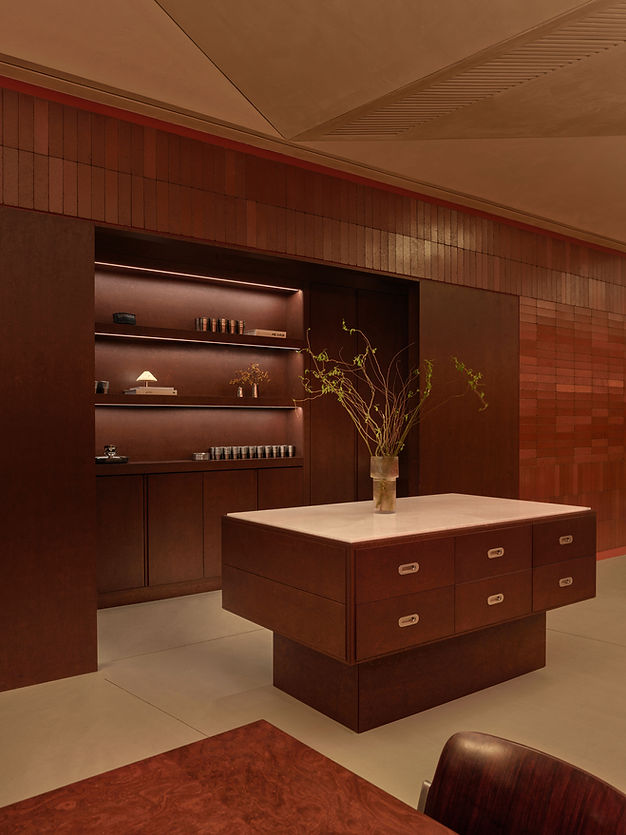
The plan organization was developed to balance operational requirements with spatial experience. In line with the open-kitchen brief, the kitchen and bar were positioned along the two sides, while the entrance axis was defined centrally. An island servant placed on this axis was conceived as both a visual and functional focal point. While operating as a service element during daytime use, it was designed to transform into a DJ setup during late hours, allowing the space to adapt to different intensities and atmospheres throughout the day.
The entire interior was organized around movable furniture. This decision was not merely a response to the limited size of the space, but the result of an approach that prioritizes adaptability. Rather than relying on fixed layouts, the design allows the space to reconfigure itself according to varying crowd sizes, events, and usage scenarios. In this way, AINEN was conceived not for a single, static moment, but for a sequence of evolving moments and experiences.


Material choices did not aim to directly imitate the historical context of Tersane İstanbul. Instead, a language was adopted in which old and new coexist. The dark-stained wooden chairs from the Giancarlo Piretti for Cassina series were consciously selected as part of this approach. These pieces, which gain value as they age, form a layer that does not resist time but evolves with it within AINEN’s contemporary spatial framework. This attitude aligns with the site’s own sense of historical continuity.
Although AINEN possesses a strong architectural form, it was approached with the understanding that form alone does not define the space. The project was conceived as an experiential field shaped by use, movement, time, and atmosphere. Rather than being fixed to a single typology, it offers a spatial proposition that moves fluidly between programs—context-aware yet firmly contemporary in its stance.
The lighting strategy was developed to support this variable condition. Spot lighting was intentionally avoided; instead, a controlled, layered lighting system was designed to work in conjunction with the ceiling geometry and architectural surfaces. Lighting was treated not as a decorative element, but as a spatial tool—one that can recede or come forward depending on use, guiding atmosphere and perception rather than locking the space into a single mood.


